Page Compiled By: Martin Melaugh
The linked pages listed below have been compiled by Dr Helen Brocklehurst, formerly Research Officer with INCORE at the University of Ulster. The views expressed in these pages do not necessarily reflect the views of the members of the CAIN Project. The CAIN Project would welcome other material which meets our guidelines for contributions.
A Summary of the Issues
It is increasingly recognised that childrens involvement in the Troubles has been complex and wide ranging though little documented. Their roles and experiences as victims, perpetrators and peacemakers will cast a long shadow into the future of a stable peace in Northern Ireland.
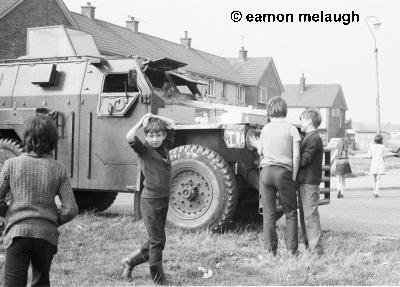
Since the first ceasefire in 1994 an increasing number of projects have documented the impact of the troubles on children and young people, including the numbers killed and injured as a result and the emotional and psychological effects on them. Childrens experiences of political violence may vary widely between geographical areas, within communities, at different times of their childhood and between girls and boys. They may be harassed and pressured from within their community as well as targeted from outside or experience harassment and violence from the security forces.
Children have also carried out acts of political violence and participated widely in paramilitary and sectarian organisations.
Participation in political violence may be underpinned by understandings of nationalism and identity fostered through segregated schooling. Several major studies have also attempted to get behind the classroom door to assess if and how children are socialised into sectarianism.
There are also many initiatives which have sought to bring an end to violence using children as peacemakers and bearers of cross community initiatives including Education for Mutual Understanding (EMU) integrated schools, holidays and cultural activities.
selected reading list
background information
Main Pages
Brocklehurst, Helen, 'The nationalisation and militarisation of Children in Northern Ireland', Chapter from PhD Thesis in International Politics titled: Children as Political Bodies: Concepts, Cases and Theories. University of Wales, 1999.
Cairns, Ed, Caught in Crossfire: Children and the Northern Ireland Conflict, Belfast: Appletree Press, 1987.
Connolly, P. and Maginn, P. Children, Sectarianism and Community Relations in Northern Ireland. Centre for the Study of Conflict, University of Ulster, 109pp, 1999
McAlister, Siobhán., Scration, Phil., and Haydon, Deena. (2009). Childhood in Transition: Experiencing Marginalisation and Conflict in Northern Ireland, (November 2009), [PDF; 3172KB]. Belfast: Childhood, Transition and Social Justice Initiative, Queen's University.
See the associated website of The Cost of the Troubles Study
for details, and extracts, from relevant publicationsSee the associated website of the Centre for the Study of Conflict
for details, and extracts, from relevant publications
Views of young people
Young Life and Times (YTL) Survey. From 1998 to 2000, the Young Life and Times survey recorded the views of 12 to 17 year olds in Northern Ireland. This survey ran alongside the Northern Ireland Life and Times Survey. In 2003 a new Young Life and Times Survey was launched which asked the views of 16 year olds. The results of these surveys are available at the Young Life and Times web site {external_link}.
Statistics
See the statistical analysis in Chapter 3 of 'Half the Battle'
See the Sutton database of deaths
Photographs
Series of 51 photographs of children and the conflict.
Part of a larger collection taken in Derry between 1968 and 1974 by Eamon Melaugh
List of other source material
CAIN contains information and source material on the conflict and politics in Northern Ireland.
CAIN is based within Ulster University.