Text: Bowes Egan and Vincent McCormack
Page Compiled By: Fionnuala McKenna
The following text has been contributed by the authors, Bowes Egan and Vincent McCormack, with the permission of LRS Publishers. The views expressed in this chapter do not necessarily reflect the views of the members of the CAIN Project. The CAIN Project would welcome other material which meets our guidelines for contributions.
BURNTOLLET
by Bowes Egan and Vincent McCormack (1969)
Published by:
L.R.S. Publishers
48 Notting Hill Gate
London
W.11
paperback 64pp
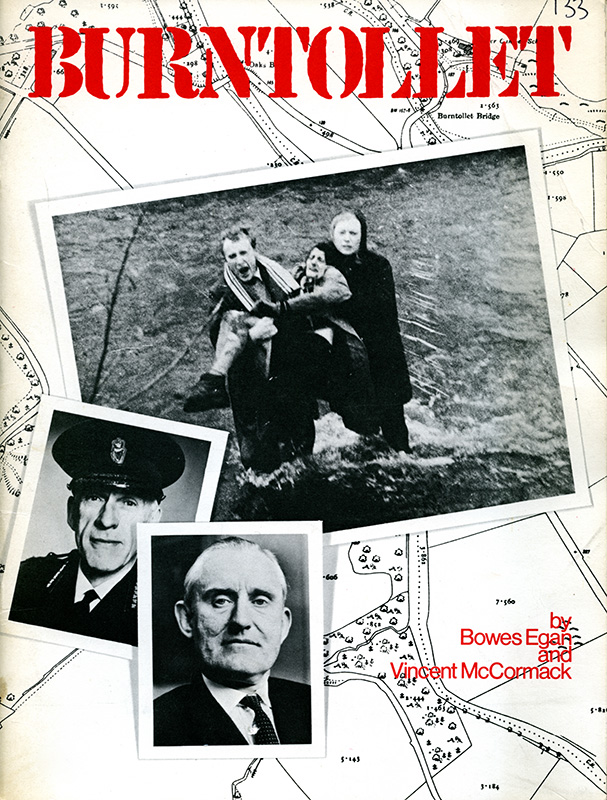
Photographs by:
Beaverbrook Newspapers
and Belfast Telegraph
This material is copyright Bowes Egan and Vincent McCormack, 1969 and is included on the CAIN site by permission of L.R.S. Publishers. You may not edit, adapt, or redistribute changed versions of this for other than your personal use without the express written permission of the publishers. Redistribution for commercial purposes is not permitted.
Contents
INTRODUCTION
OPPONENTS of the Northern Ireland government accuse it of operating a police state. The Ulster Unionists, who have held control for nearly half a century, make automatic denial each time this charge is urged.
Undocumented allegations and blanket disclaimers do not help towards fair assessment. For seven months we have examined what happened during a Civil Rights march from Belfast to Derry. We have also looked to the aftermath of this demonstration, its consequences, and action taken by the authorities.
We are not primarily interested in reciting what happened to students and other young people who set out on the road, hoping to break through barriers of religious bigotry by directing attention to social and economic issues. We have tried to produce a study of Northern Ireland government in action. During their march the walkers learned much of police behaviour and political attitudes through a series of sharp object lessons. We have tried to establish facts, identify participants, and assess the parts they played.
The Northern Ireland unit was created in 1920 to appease the fears of a substantial Protestant majority faced with the prospect of inclusion in a Catholic-dominated, all-Ireland state. The Belfast Parliament was given control of matters of local importance, though the British Parliament retained wide powers to intervene. These have not been exercised.
From the outset, political attitudes in the new unit were wedded to religious persuasion. Critics argue that this has been disastrous for most of the people. It benefits only the ruling caste within the Ulster Unionist Party. This body is assured of continued power by the adherence of the majority of all classes of Protestants. As this power relies upon the enduring nature of old fanaticisms, official antipathy, previously reserved for those who were opposed to the existence of the Northern Ireland state, now extends to those who campaign against the religious divide.
We offer no exhaustive assessment of how the Unionist Party has governed during 50 years of near-absolute power, but seek to tell what we have discovered about the rule of law in Northern Ireland. The incidents described raise important questions about police and governmental partiality, and about the use of mobs to implement official policy. Our description should allow each reader to decide whether the appellation police state" should be applied to this area, and will permit him to assess how well the government has adhered to the principles underlying one of the most potent and cherished Unionist catch-cries: "For civil and religious liberty".
CAIN contains information and source material on the conflict and politics in Northern Ireland.
CAIN is based within Ulster University.