Text: Dr. Robbie McVeigh
Page Compiled By: Fionnuala McKenna
The following extracts have been contributed by the author Dr. Robbie McVeigh with the permission of the publishers. The views expressed in this chapter do not necessarily reflect the views of the members of the CAIN Project. The CAIN Project would welcome other material which meets our guidelines for contributions.
These extracts are taken from:
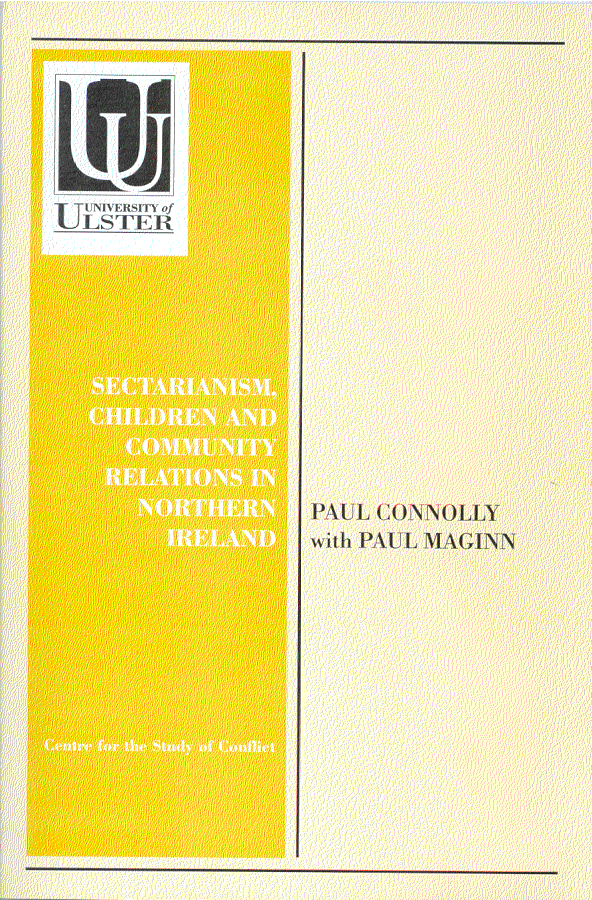
"Sectarianism, Children and Community Relations in Northern Ireland"
by Paul Connolly with Paul Maginn
Published by the University of Ulster, Coleraine 1999
ISBN 1 85923 135 7
Paperback 109pp £6.00
Out of Print
There are extracts from the report below and the full text of the report is available at: http://www.paulconnolly.net/publications/report_1999b/index.htm {external_link}
This material is copyright of the Centre for the Study of Conflict and the author(s) and is included on the CAIN web site with the permission of the publisher. Reproduction or redistribution for commercial purposes is not permitted.
SECTARIANISM, CHILDREN AND COMMUNITY RELATIONS IN NORTHERN IRELAND
Paul Connolly
with the assistance of Paul Maginn
University of Ulster
Centre for the Study of Conflict
ACKNOWLEDGEMENTS
I would like to thank the Centre for the Study of Conflict at the University of Ulster for its help and support in the publication of this report. I am also extremely grateful to the Centre for Voluntary Action Studies, also at the University of Ulster, who funded the exploratory study that forms part of this Report.
I am also indebted to the two schools where the study was based and especially the teaching staff for their interest in and support of the project. Most importantly, I would like to thank the children who form the focus of the study for their co-operation and openness. I am also grateful to Sam McCready, Brendan Murtagh, Bill Rolston, Karen Winter and the Youth Council for Northern Ireland for offering invaluable comments on earlier drafts of this report. In addition, significant parts of Chapter 3 draw upon an article of mine that is soon to appear in the journal, Race Ethnicity and Education.
Finally, I am indebted to Paul Maginn who conducted all of the interviews with the children, the teaching staff and with the youth club leaders and community workers. However, as I have taken the responsibility of analysing the data and writing the report then any faults and/or inconsistencies are my own.
Dr Paul Connolly
School of Social and Community Sciences
University of Ulster
Magee College
L'Derry BT48 7JL
Northern Ireland
July 1999
Preface
The impact of the conflict in Northern Ireland on children, and the related question of the emergence and development of prejudice, has produced a large and varied literature. The new research reported here by Paul Connolly and Paul Maginn takes a close and critical look at this literature and uses the conclusions wrought from this examination to present ideas about how such work can be extended and taken in new directions.
The review of existing work is very balanced and fair, acknowledging the intellectual rigour and innovative approaches developed in attempts to penetrate the hidden worlds and world views of children. The importance of the contact hypothesis as a source of ideas and research approaches is also acknowledged, but this is accompanied by an illuminating and constructive critique of some understanding of this hypothesis.
The review leads to a series of proposals and suggestions about ways of extending and widening work on children and prejudice, including ideas relating to different contexts, different research approaches and new questions about the relative success of different forms of contact.
The report concludes with the results of a study of two P7 classes at a Catholic and a Protestant school in Northern Ireland. This exploratory but highly original study is described by the authors as an attempt to 'model out' a new and productive research technique. The results are illuminating and present strong evidence for the view (among others) that 'the expression of sectarianism among children can only by fully understood within the particular sub-cultural contexts within which it occurs.
The Centre for the Study of Conflict is pleased to add this thoughtful and imaginative study to its list of internal publications.
Seamus Dunn
July 1999
Contents
INTRODUCTION | |
CHAPTER 1: RESEARCH ON SECTARIANISM AND CHILDREN | |
| Introduction |
| Defining Sectarianism |
| Research on Children and Sectarianism in Northern Ireland |
| Critique of Research on Children and Sectarianism Conclusions |
CHAPTER 2: LEARNING FROM RESEARCH ON CHILDREN AND PREJUDICE | |
| Introduction |
| Research on Children and Ethnic Prejudice |
| Applicability of Research on Children and |
| Prejudice to the Study of Sectarianism and |
| Conclusions |
CHAPTER 3: RESEARCH ON THE CONTACT HYPOTHESIS | |
| Introduction |
| Current Debates and Controversies |
| Research on the Contact Hypothesis |
| New Directions for Research on the Contact Hypothesis |
| Conclusions |
CHAPTER 4: TOWARDS AN ALTERNATIVE METHODOLOGICAL APPROACH | |
| Introduction |
| The Present Study |
| Ethical Issues |
| Validity of the Data |
| Conclusions |
CHAPTER 5: SECTARIANISM AND CHILDREN'S PERSPECTIVES | |
| Introduction |
| The Children's Experiences of the Conflict |
| Protestant Children's Perspectives |
| Catholic Children's Perspectives |
| Developing Anti-sectarian Work |
| Conclusions |
CHAPTER 6: CHILDREN AND CONTACT SCHEMES | |
| Introduction |
| Northside and Southside Youth Clubs |
| The Children's Sub-cultures |
| Boyfriends, Girlfriends and Youth Club Discos |
| Youth Club Discos and Contact Schemes |
| Conclusions |
CHAPTER 7: SUMMARY AND RECOMMENDATIONS | |
| Introduction |
| Summary and Conclusions |
| Recommendations for Future Research |
REFERENCES | |
INTRODUCTION
It was during the relatively high levels of violence and conflict of the early 1970s that concerns were first voiced about the effects of sectarianism on the lives of children and young people (Fields 1973; Fraser 1974). While, in retrospect, these early studies appear to have been a little sensationalist and anecdotal, they did open up a debate that has attracted much research attention and popular interest over the ensuing decades (Gough et al. 1992; Trew 1992; Cairns et al. 1995; Cairns and Cairns 1995). One of the most recent reports, offering an important insight into the actual experiences and perspectives of children and young people growing up in Northern Ireland, seems to confirm that their day-to-day lives remain significantly influenced by sectarianism and the effects of the conflict (Smyth 1998).
It is not surprising that children and young people should provide the focus of so much academic and political attention. Most fundamentally, they represent 'the future'. While there may exist a relatively pessimistic attitude towards the ability to mend bridges and resolve conflict among the adult population, children and young people are often regarded as less 'entrenched' and more receptive to new ways of thinking. It may well be because they are seen as holding the key to the future that some of the most concerted and sustained attempts at community relations work has been aimed at this age group. This is most evident in terms of the official sanctioning of community relations strategies at this level through the introduction of 'Education for Mutual Understanding' and 'Cultural Heritage' as cross-curricular themes within the national curriculum. While the actual impact of these statutory requirements on schools has been variable (Smith and Robinson 1996), there is no doubt that they have at least contributed to an increasing focus on the need 'to do something' with children and young people in respect of community relations work.
The most significant and widespread practical response to this perceived need has undoubtedly been the use of cross-community contact schemes. Since the Department of Education for Northern Ireland (DENI) first provided funds for such schemes between schools in 1987, the number of schools participating has risen from 15 percent at that time to 45 per cent in 1995 (Smith and Robinson 1996). A similar picture also emerges within the Youth Service where it is has recently been reported that 65 per cent of full-time youth clubs, 32 per cent of part-time youth clubs and 38 per cent of uniformed organisations currently participate in cross-community contact schemes (Youth Council for Northern Ireland 1998). Moreover, the same report goes on to show that when the use of single identity work is also taken into consideration then the clear majority of youth organisations have been found to involve themselves in some form of community relations work (85 per cent of full-time, 60 per cent of part-time and 68 per cent of uniformed organisations). Overall, the effects of such work certainly appears to be encouraging with a significant majority of young people surveyed believing that 'their involvement had resulted in a more positive perception towards those from other religious traditions' and, for those involved in more frequent and sustained community relations work, they were 'significantly more likely to have inter-religious friendships, and less likely to perpetrate sectarian bullying than those not involved' (Youth Council for Northern Ireland 1998: iv).
The outlook for community relations work with children and young people, at least for the foreseeable future, also appears to be extremely positive. In relation to schools, for example, DENI's current Strategic Plan for 1996-2000 underlines its own continuing commitment to 'community relations work by identifying it as one of the four key priorities for action for the education service. As DENI reiterate:
Schools have a vital part to play in strengthening the cohesion of Northern Ireland society. The ethos imparted in the school environment has an enduring impact. Contact between pupils of different backgrounds will continue to be promoted through the Cross-Community Contact Scheme, so as to build respect for, and understanding of, different cultural traditions. Education for Mutual Understanding will remain an important theme in the Northern Ireland Curriculum. Integrated schools also contribute to this important objective (DENI 1997: Section 4.19).
The recent publication by DENI of a revised curriculum for youth work appears to afford community relations an even stronger role in relation to the work of the Youth Service (DENI 1998). In identifying personal and social development as being the central theme of youth work, DENI identify three core principles that should underpin the curriculum of youth work in order to achieve this. One of these three principles is the 'acceptance and understanding of others'. In offering a rationale for the identification of this core principle, DENI argue that:
It is important that youth workers appreciate that they are valuable role models and they have the potential to impart to young people the values of compassion, understanding and acceptance of others. By their example, they can do much to promote these values within their own units and can encourage the extension of such acceptance and understanding to other groups of young people within and beyond their local communities ... Youth workers cannot ignore the major features of life which, in the context of Northern Ireland, polarise and divide young people, allow them to stereotype and categorise each other, and lead many of them into direct confrontation. Over the past 28 years, initiatives to promote greater acceptance and understanding of difference have emerged under a variety of community relations initiatives. This is vital work, if a tolerant and peaceful society is to be created. Youth workers are often well placed to help young people to arrive at a better understanding of their own beliefs, culture and sexuality, to acknowledge and accept the diversity of their own communities, to challenge prejudice, and to pursue equality of opportunity for themselves and for others (DENI 1998:10-11).
Interestingly, we have now reached a significant point in the development of community relations work for children and young people. DENI has recently engaged in an informal consultation process with regard to its own Strategic Plan. This is hoped to pave the way for a formal review of the Plan in April/May next, subject to the establishment of a Ministerial Executive as part of the Northern Ireland Assembly. Moreover, the Youth Service is, itself, coming to the end of a fundamental review of its future role and scope. It is not only reviewing the current objectives set for the Service but also, more fundamentally, the age-ranges the Service should target, how to include young people and the wider community more centrally in the Service and how the Service relates to other agencies and organisations (Youth Service Policy Review 1998a, 1998b). The final Report is due at any time with an anticipated policy statement by the Minister in March 1999.
It therefore also seems an opportune moment to reflect upon and evaluate the contribution that research has made to community relations work with children and young people and to consider its future role. This is the main purpose of the current Report. In offering a detailed review of research on children and sectarianism and on the contact hypothesis more generally, the Report will draw attention to the continuing gaps in our understanding and will suggest alternative directions for future research in terms of methodology and focus. In then drawing upon data gained from an exploratory qualitative study focusing on the experiences and perspectives of 10 and 11 year old children, the Report also aims not only to 'model out' a more effective research approach to the study of sectarianism, children and community relations work but will also offer some tentative indication of the nature and extent of the issues to be addressed.
Chapters One to Three, therefore, offer comprehensive reviews and evaluations of existing research on sectarianism and children and on the contact hypothesis respectively. Chapter Four draws together the main implications of these preceding reviews and sets out the central elements of an alternative methodological approach to the study of sectarianism, children and community relations. It also provides details of the specific methods used in the present exploratory study. Chapters Five and Six then provide an example of how this alternative methodology can be applied by offering the main findings of the exploratory study. Chapter Five focuses on the nature and forms that sectarianism takes among the children while Chapter Six offers a brief analysis of the impact and effects that a particular contact scheme organised between two respective youth clubs has had on the children's attitudes and behaviour. Finally, Chapter Seven, provides a summary of the key issues raised by the Report in terms of both the general research approaches that have been adopted in relation to sectarianism, children and community relations work and the issues arising from the exploratory study with respect to policy and practice. The chapter concludes with a number of recommendations in relation to the implications of this for future research, policy and practice in the area.
CHAPTER 7 - SUMMARY AND RECOMMENDATIONS
Introduction
The purpose of this Report has been twofold:
To provide a review and assessment of the contribution that existing research has made to our understanding of sectarianism and community relations work with children;
To suggest and 'model out' an alternative methodological approach for future research that has the potential to make a significant contribution to the refinement and development of community relations policy and practice for children.
It has been stressed throughout that the small-scale and limited nature of the case study means that it is dangerous to use it as a basis to develop generalisations about youth clubs and/or contact schemes. In line with the above, the primary purpose of the case study has simply been to demonstrate the type and quality of data that can be generated from the alternative methodological approach that has been proposed. However, while by no means representative, the case study has produced some useful insights into the nature of sectarianism and community relations work with children.
What follows is a summary of the key issues raised in the Report together with the main conclusions drawn. This will be followed by a set of recommendations concerning the future direction of research on sectarianism and community relations work with children.
Summary and Conclusions
Sectarianism and children
It is reasonable to assume that children, from about the age of three, are able to develop an understanding of the categories of 'Protestant' and 'Catholic' (although possibly not using those precise terms) and to apply negative characteristics to these.
These initial categorisations can be understood to have an 'imprinting effect' where they progressively become embedded within the children's ways of thinking and behaving. With time, and as children are exposed to broader social contexts and experiences, they will come to develop more elaborate and sophisticated ways of identifying, categorising and evaluating others.
Sectarianism is not confined to individual prejudices and beliefs but is manifest in, and reproduced by, peer-group relations and sub-cultures and a range of broader social, political and economic structures.
The expression of sectarianism among children is rooted in their day-to-day experiences. For some, it appears to provide the interpretative lens through which they develop a keen interest in and understanding of the news and politics of the conflict.
The expression of sectarianism among children can therefore only be fully understood within the particular sub-cultural contexts within which it occurs.
The findings of the exploratory study would appear to suggest that children are not passive receptacles to be filled with the sectarian beliefs and value-systems of their parents but are actively and competently involved in appropriating, re-working and reproducing these sectarian beliefs in order to make sense of their own expenences.
Community relations work with children
Given the fact that sectarianism is to be found at all levels of society - from the systemic and structural to the sub-cultural and subjective - any community relations strategy needs to be similarly multilayered and involve effective interventions at all of these levels.
Children and young people appear to have gained overwhelmingly positive experiences from cross-community contact schemes. Such schemes will inevitably continue to provide an important element to any community relations strategy in their potential to address sectarianism and foster respect and mutual tolerance at the subcultural and subjective levels.
Given the fact that sectarianism will manifest itself differently from one context to the next, the nature and content of community relations work and, within this, each contact scheme should be carefully planned in relation to the existing needs and experiences of the children in any one area.
Whatever the current situation in any particular area, it is clear that community relations work needs to engage directly with their perspectives and experiences, whatever these may be. In relation to the children in the present case study, this should also involve helping them to work through their own anxieties and fears.
Cross-community contact schemes should play a key role in this type of approach. However, it will require the continued training and support of those organising such schemes and also will inevitably require appropriate work with the children prior to and then following the contact.
Some form of community relations work with children needs to begin as soon as they are capable of being influenced by sectarianism which, from the available evidence, appears to be from about the age of three onwards. Certainly, the available research suggests that children of this age, with the appropriate help and support, are capable of reflecting upon their own attitudes and behaviour (see Connolly 1999).
When discussing the importance of finding neutral venues for cross-community contact to take place, the current case study would suggest that this should include consideration of the socio-cultural context as well as the geographical location.
Recommendations for Future Research
Given the above summary, a number of general recommendations arise in relation to the future direction of research on sectarianism and community relations work with children.
In contributing to our understanding of the nature and influence of sectarianism in children's lives, research needs to adopt a much more qualitative, ethnographic approach that focuses on the children's own experiences and perspectives.
Through the use of a broadly ethnographic approach, such experiences and perspectives need to be contextualised within the broader social contexts within which the children are located including the sub-cultures of their peer groups and the wider processes and practices evident within their locality.
Within this overall methodological approach, a much more comprehensive picture needs to be constructed of how the influences and effects of sectarianism are likely to develop and change with age. Such an understanding is essential if a realistic and appropriate community relations curriculum is to be developed for children aged 3 - 11 years.
Similarly, an understanding of the effects of particular contact schemes and the underlying reasons for these will only be gained from such a qualitative ethnographic focus. As before, such schemes cannot be studied in isolation but rather their influences and effects on children's attitudes and behaviour can only be understood through a consideration of the wider social contexts within which they take place.
REFERENCES
Aboud, F (1988) Children and Prejudice. Oxford: Basil Blackwell.
Aboud, F. and Doyle, A. (1993) 'The early development of ethnic identity and attitudes', in M. Bernal and G. Knight (Eds.) Ethnic Identity: Formation and Transmission Among Hispanics and Other Minorities, Albany, NY: State University of New York Press.
Aboud, F. and Doyle, A. (1996) 'Does talk of race foster prejudice or tolerance in children?' Canadian Journal of Behavioural Science, 28 (3): 161-70.
Allport, G. W. (1954) The Nature of Prejudice. Cambridge MA: Addison-Wesley.
Alreshoud, A. & Koeske, G. F. (1997) 'Arab students' attitudes toward and amount of social contact with Americans: a causal process analysis of cross-sectional data', The Journal of Social Psychology, 137 (2): 235-245.
Back, L. (1996) New Ethnicities and Urban Culture. London: UCL Press.
Barr, S. (1977) 'The effect of Northern Irish religious cues on children's category clustering', unpublished BSc thesis, University of Ulster.
Bar-Tal, D. (1996) 'Development of social categories and stereotypes in early childhood: the case of "the Arab" concept formation, stereotype and attitudes by Jewish children in Israel', International Journal of Intercultural Relations, 20 (2/4): 34 1-70.
Beloff, H. (1989) 'A tradition of threatened identities', in J. Harbison (Ed.) Growing Up in Northern Ireland. Belfast: Stranmillis College.
Bigler, R. and Liben, L. (1993) 'A cognitive-developmental approach to racial stereotyping and reconstructive memory in Euro-American children', Child Development, 64: 1507-15 19.
Brewer, J. (1992) Sectarianism and racism and their parallels and differences, Ethnic and Racial Studies, 15 (3): 352-364.
Brewer, M. B. & Miller, N. (1984) 'Beyond the contact hypothesis: theoretical perspectives on desegregation', in N. Miller & M. Brewer (Eds.) Groups in Contact: The Psychology of Desegregation. New York: Academic Press.
Brewer, M. B. (1996) 'When contact is not enough: social identity and intergroup cooperation', International Journal of Intercultural Relations, 20 (3/4): 291-303.
Brown, R. J. & Turner, J. C. (1981) 'Interpersonal and intergroup behaviour', in I. Turner & H. Giles (Eds.) Intergroup Behaviour. Chicago: University of Chicago Press.
Cairns, E. (1976) 'Children's category clustering of stereotypic Catholic and Protestant names: the influence of age', unpublished paper, University of Ulster.
Cairns, E. (1977) 'An investigation of the salience for young children in Northern Ireland of adult generated stereotypic Protestant and Catholic first names', unpublished paper read to the London Conference of the British Psychological Society.
Cairns, E. (1978) 'Familiarity for stereotypic Catholic and Protestant names: the influence of age and segregated vs. integrated schooling', unpublished paper, University of Ulster.
Cairns, E. (1980) 'The development of ethnic discrimination in children in Northern Ireland', in J. Harbison and J. Harbison (Eds.) A Society Under Stress: Children and Young People in Northern Ireland. Somerset: Open Books.
Cairns, E. (1983) 'The political socialisation of tomorrow's parents: violence, politics and the media', in J. Harbison (Ed.) Children of the Troubles: Children in Northern Ireland. Belfast: Stranmillis College.
Cairns, E. (1987) Caught in the Crossfire: Children and the Northern Ireland Conflict. Belfast: Appletree Press.
Cairns,E. and Cairns,T. (1995) 'Children and conflict: a psychological perspective', in S. Dunn (Ed.) Facets of the Conflict in Northern Ireland. Basingstoke: Macmillan.
Cairns, E. and Duriez, R. (1976) 'The influence of speaker's accent on recall by Catholic and Protestant school children in Northern Ireland', British Journal of Social and Clinical Psychology, 15: 441-2.
Cairns, E., Hunter, D. and Herring, L. (1978) 'Young children's awareness of violence in Northern Ireland: the influence of Northern Irish television in Scotland and Northern Ireland', unpublished paper presented to the annual conference of the N. I. Branch of the British Psychological Society, Virginia, Co. Cavan, Ireland.
Cairns, E., Hunter, D. and Herring, L. (1980) 'Young children's awareness of violence in Northern Ireland: the influence of N.I. television in Scotland and Northern Ireland', British Journal of Social and Clinical Psychology, 19: 3-6.
Cairns, E., Wilson, R., Gallagher,T. and Trew, K. (1995) 'Psychology's contribution to understanding conflict in Northern Ireland', Peace and Conflict: Journal of Peace Psychology, 1(2): 13 1-48.
Carrington, B. and Short, G. (1989) 'Race' and the Primary School. Windsor: NFER-NELSON.
Cohen, S. and Horm-Wingerd, D. (1993) 'Children and the environment: ecological awareness among preschool children', Environment and Behaviour, 25 (1): 103-20.
Comer, J. (1989) 'Racism and the education of young children', Teacher College Record, 90 (3): 352-6 1.
Connolly, P. (1995) 'Racism, masculine peer-group relations and the schooling of African/Caribbean infant boys', British Journal of Sociology of Education, 16 (1): 75-92 (1995).
Connolly, P. (1996) "'Seen but never heard": rethinking approaches to researching racism and young children', Discourse. Studies in the Cultural Politics of Education, 17 (2), pp. 17 1-85.
Connolly, P. (1997) 'In search of authenticity: researching young children's perspectives', in A. Pollard, D. Thiessen and A. Filer (Eds.) Children and their Curriculum: The Perspectives of Primary and Elementary School Children. London: Falmer Press.
Connolly, P. (1998a) Racism, Gender Identities and Young Children. London: Routledge.
Connolly, P. (1998b) "'Dancing to the wrong tune": ethnography, generalization and research on racism in schools', in P. Connolly & B. Troyna (Eds.) Researching Racism in Education: Politics, Theory and Practice. Buckingham: Open University Press.
Connolly, P. (1999) Community Relations Work with Preschool Children. Belfast: Community Relations Council.
Corenblum, B. and Annis, R. (1987) 'Racial preference and identity in Native and White Canadian children', Canadian Journal of Behavioural Science, 19: 254-265.
DENI (Department of Education for Northern Ireland) (1997) Strategic Plan for Education 1996-2000. <http://www.deni.gov.uk/life/ ppse.htm>.
DENI (Department of Education for Northern Ireland) (1998) Youth Work: A Mode for Effective Practice. Bangor: DENI.
Denscombe, M., Szulc, H., Martin, C. and Wood, A. (1986) Ethnicity and friendship: the contrast between sociometric research and fieldwork observation in primary school classrooms, British Educational Research Journal, 12 (3): 22 1-35.
Deschampes, J. C. & Brown, R. J. (1983) 'Superordinate goals and inter-group conflict', British Journal of Social Psychology, 22:189-195.
Desforges, D. M., Lord, C. G., Pugh, M. A., Sia, T. L., Scarberry, N. C. & Ratcliff, C. D. (1997) ' Role of group representativeness in the generalisation part of the contact hypothesis', Basic and Applied Social Psychology, 19 (2): 183-204.
Devine, P. (1989) 'Stereotypes and prejudice: their automatic and controlled components', Journal of Personality and Social Psychology, 56: 5-18.
Doyle, A. and Aboud, F. (1995) 'A longitudinal study of white children's racial prejudice as a social-cognitive development', Merrill-Palmer Quarterly, 41(2): 209-28.
Ellison, C. G. & Powers, D. A. (1994) 'The contact hypothesis and racial attitudes among black Americans' ,Social Science Quarterly, 75 (2): 385-400.
Epstein, D. (1997) 'Cultures of schooling/cultures of sexuality', International Journal of Inclusive Education, 1 (1), pp. 37-53.
Fee, M. (1981) 'Religious prejudice in Northern Ireland?' Unpublished BA thesis, Queen's University of Belfast.
Ferguson, N. and Cairns, E. (1996) 'Political violence and moral maturity in Northern Ireland', Political Psychology, 17 (4): 713-25
Fields, R. (1973) A Society on the Run: A Psychology of Northern Ireland. .Harmondsworth: Penguin.
Fitzduff, M. (1995) Managing community relations and conflict: voluntary organisations and government and the search for peace, in N. Acheson and A. Williamson (Eds.) Voluntary Action and Social Policy in Northern Ireland. Aldershot: Avebury.
Ford, W. 5. (1986) 'Favourable intergroup contact may not reduce prejudice: inconclusive journal evidence, 1960-1984', Sociology and Social Research, 70: 256-258.
Fraser, M. (1974) Children in Conflict. Harmondsworth: Penguin.
Gaertner, S. L., Dovidio, J. F. & Bachman, B. A. (1996) 'Revisiting the contact hypothesis: the induction of a common ingroup identity', International Journal of Intercultural Relations, 20(3/4): 27 1-290.
Gillborn, D. (1995) Racism and Antiracism in Real Schools. Buckingham: Open University Press.
Ginsburg, N. (1992) 'Racism and housing: concepts and reality', in P. Braham et al. (Eds.) Racism and Anti racism. London: Sage.
Gough, B., Robinson, S., Kremer, J. and Mitchell, R. (1992) 'The social psychology of intergroup conflict: an appraisal of Northern Ireland research', Canadian Psychology, 33 (3): 645-50.
Grugeon, E. (1993) 'Gender implications of children's playground culture', in P. Woods & M. Hammersley (Eds.) Gender and Ethnicity in Schools: Ethnographic Accounts. London: Routledge.
Hall, R. (1993) 'How children think and feel about war and peace: an Australian study', Journal of Peace Research, 30 (2): 18 1-96.
Hamburger,Y (1994) 'The contact hypothesis reconsidered: effects of the atypical outgroup member on the outgroup stereotype', Basic and Applied Social Psychology, 15 (3): 339-358.
Hammersley, M. (1992) What's Wrong With Ethnography? London: Routledge.
Hatcher, R. (1995) 'Boyfriends, girlfriends: gender and "race" in children's cultures', International Play Journal, 3, pp. 187-97.
Hewstone, M. & Brown, R. (1986) 'Contact is not enough: an intergroup perspective on the "contact hypothesis"', in M. Hewstone & R. Brown (Eds.) Contact and Conflict in Intergroup Encounters. Oxford: Basil Blackwell.
Hirschfeld, L. (1993) 'Discovering social differences: the role of appearance in the development of racial awareness', Cognitive Psychology, 25: 3 17-50.
Hirschfeld, L. (1994) 'The child's representation of human groups', in D. Medin (Ed.) The Psychology of Learning and Motivation. San Diego: Academic Press.
Hosin, A. and Cairns, E. (1982) 'Political consciousness in children in Northern Ireland', unpublished paper presented to the Annual Conference of the British Psychological Society, Aberdeen.
Houston, J., Crozier, W. and Walker, P. (1990) 'The assessment of ethnic sensitivity among Northern Ireland schoolchildren', British Journal of Developmental Psychology, 8: 4 19-22.
Jackman, M. R. & Crane, M. (1986) "'Some of my best friends are black": interracial friendship and whites' racial attitudes', Public Opinion Quarterly, 50: 459-486.
Jahoda, G. and Harrison, 5. (1975) 'Belfast children: some effects of a conflict environment', Irish Journal of Psychology, 3:1-19.
Kehily, M. and Nayak, A. (1996) "'The Christmas Kiss": sexuality, story-telling and schooling', Curriculum Studies, 4 (2), pp. 211-27.
Kehily, M. and Nayak, A. (1997) "'Lads and laughter": humour and the production of heterosexual hierarchies', Gender and Education, 9 (1), pp. 69-87.
Knight, G., Bernal, M., Cota, M., Garza, C. and Ocampo, K. (1993a) 'Family socialisation and Mexican American identity behaviour', in M. Bemal and G. Knight (Eds.) Ethnic Identity: Formation and Transmission Among Hispanics and Other Minorities. Albany NY: State University of New York Press.
Knight, G., Bernal, M., Garza, C., Cota, M. and Ocampo, K. (1993b) 'Family socialisation and the ethnic identity of Mexican American children', Journal of Cross-Cultural Psychology, 24: 99-114.
Knight, G., Cota, M. and Bernal, M. (1993c) 'The socialisation of cooperative, competitive and individualistic preferences among Mexican American children: the mediating role of ethnic identity', Hispanic Journal of Behavioural Sciences, 15: 291-309.
Lawless, A. (1981) 'Understanding of and identity with national and religious groups in young Northern children: the influence of conflict and contact', unpublished BA thesis, Queen's University of Belfast.
Logue, K. (1993) Anti-Sectarian Work: A Framework for Action. Belfast: Community Relations Council.
Marcos, H. and Verba, M. (1997) 'The influence of social context on requests in young Iranian children', International Journal of Psychology, 32 (4): 209-19.
McAuley, P and Kremer, J. (1990) 'On the fringes of society: adults and children in a West Belfast community', New Community, 16 (2): 247-59.
McClenahan, C., Cairns, E., Dunn, S. and Morgan, V. (1991) 'Preference for geographical location as a measure of ethnic/national identity in children in Northern Ireland ',Irish Journal of Psychology, 12 (3): 346-54.
McGrath, A. and Wilson, R. (1985) 'Factors which influence the prevalence and variation of psychological problems in children in Northern Ireland', unpublished paper presented to the Annual Conference of the Development Section of the British Psychological Society, Belfast.
McVeigh, R. (1995) Cherishing the children of the nation unequally: sectarianism in Ireland, in P Clancy, S. Drudy, K. Lynch and L. O'Dowd (Eds.) Irish Society: Sociological Perspectives. Dublin: Institute of Public Administration.
McWhirter, L. (1983) 'Looking back and looking forward: an inside perspective', in J. Harbison (Ed.) Children of the Troubles: Children in Northern Ireland. Belfast: Stranmillis College.
McWhirter, L. and Gamble, R. (1982) 'Development of ethnic awareness in the absence of physical cues', Irish Journal of Psychology, 5 (2): 109-27.
Milner, D. (1983) Children and Race: Ten Years On. London: Ward Lock Educational.
Ocampo, K., Knight, G. and Bernal, M. (1997) 'The development of cognitive abilities and social identities in children: the case of ethnic identity', International Journal of Behavioural Development, 21 (3): 479-500.
Pettigrew, T. F. (1971) Racially Separate or Together? New York: McGraw-Hill.
Pettigrew, T. F. (1997) 'Generalised intergroup contact effects on prejudice', Personality and Social Psychology Bulletin, 23(2): 173-185.
Playboard (1997) Games Not Names. Belfast: Playboard and Community Relations Council.
Powers, D. A. & Ellison, C. G. (1995) 'Interracial contact and black racial attitudes: the contact hypothesis and selectivity bias', Social Forces, 74 (1): 205-226.
Ramsey, P. (1991) 'The salience of race in young children growing up in an all-white community', Journal of Educational Psychology, 83 (1): 28-34.
Reicher, 5. (1986) 'Contact, action and racialisation: some British evidence', in M. Hewstone & R. Brown (Eds.) Contact and Conflict in Intergroup Encounters. Oxford: Basil Blackwell.
Robinson, J. & Preston, J. (1976) 'Equal-status contact and modification of racial prejudice: a re-examination of the contact hypothesis', Social Forces, 54: 911-924.
Ruddle, H. and O'Connor, J. (1992) A Model of Managed Co-operation: An Evaluation of Co-operation North's School and Youth Links Scheme. Limerick: Irish Peace Institute, University of Limerick.
Sayer, A. (1992) Method in Social Science. 2nd Edition. London: Routledge.
Sigelman, L. & Welch, S. (1993) 'The contact hypothesis revisited: black-white interaction and positive racial attitudes', Social Forces, 71(3): 781-795.
Smith, C. B. (1994) 'Back and to the future: the intergroup contact hypothesis revisited', Sociological Inquiry, 64 (4): 438-455.
Smith, A. & Houghton, F. (1995) Beyond Contact: An Evaluation of Cooperation North Youth, Education and Community Exchange Programme. Coleraine: Centre for the Study of Conflict, University of Ulster.
Smith, A. & Robinson, A. (1996) Education for Mutual Understanding: The Initial Statutory Years. Coleraine: Centre for the Study of Conflict, University of Ulster.
Smyth, M. (1998) Half the Battle: Understanding the Impact of the Troubles on Children and Young People. Derry/Londonderry: INCORE, University of Ulster.
Stringer, M. (1984) 'The utility of stereotypic face stimuli as disguised measures of attitudes in Northern Ireland', unpublished D.Phil thesis, University of Ulster.
Stringer, M. and Lavery, B. (1987) 'The acquisition of ethnic categorization ability by British university students in Northern Ireland', Social Behaviour, 2:157-64.
Tajfel, H. & Turner, J. C. (1986) 'The social identity theory of intergroup behaviour', in S. Worchel & W. Austin (Eds.) Psychology of lntergroup Relations. Chicago ll: Nelson-Hall.
Toner, I. (1995) 'Temporary residential cohabitation of children from Northern Ireland', Irish Journal of Psychology, 16 (1): 67-82.
Trew, K. (1981) 'Intergroup relations and the development of social identity in Northern Ireland', unpublished paper presented to the sixth biennial conference of the International Society for the Study of Behavioural Development, Ontario Institute for Studies in Education, Canada.
Trew, K. (1983) 'Ethnic identification in a divided society', in J. Harbison (Ed.) Children on the Troubles: Children in Northern Ireland. Belfast: Stranmillis College.
Trew, K. (1989) 'Evaluating the impact of contact schemes for Catholic and Protestant children', in J. Harbison (Ed.) Growing Up in Northern Ireland. Belfast: Northern Ireland Learning Resources Unit, Stranmillis College.
Trew, K. (1992) 'Social psychological research on the conflict', The Psychologist, 5: 342-4.
Trew, K. (1996) 'Review of J. Whyte "Changing Times: Challenges to Identity: 12 Year Olds in Belfast 1981 and 1992" Avebury, 1995', Irish Journal of Psychology, 17 (1): 76-8.
Troyna, B. (1987) 'Beyond multiculturalism: towards the enactment of anti-racist education in policy, provision and pedagogy', Oxford Review of Education, 13: 307-320.
Troyna, B. (1993) Racism and Education: Research Perspectives. Buckingham: Open University Press.
Troyna, B. and Carrington, B. (1990) Education, Racism and Reform. London: Routledge.
Troyna, B. and Hatcher, R. (1992) Racism in Children's Lives. London: Routledge.
Weinreich, P. (1982) 'Identity development in Protestant and Roman Catholic adolescent boys and girls in Belfast', unpublished paper presented to the 10th International Congress of the International Association for Child and Adolescent Psychiatry and Allied Professions, Dublin
Whyte, J. (1983) 'Educational enrichment with deprived children: the long term consequences', in J. Harbison (Ed.) Children on the Troubles: Children in Northern Ireland. Belfast: Stranmillis College.
Williams, R. (1947) Reduction of Intergroup Tension. New York: Social Science Research Council.
Wilson, T. C. (1996) 'Prejudice reduction or self-selection? A test of the contact hypothesis', Sociological Spectrum, 16: 43-60.
Wirth, J. L. & Lord, C. G. (19992) 'Previous conceptions of the typical group member and the contact hypothesis', Basic and Applied Social Psychology, 13 (3): 35 1-369.
Wood, P B. & Sonleitner, N. (1996) 'The effect of childhood interracial contact on adult anti-black prejudice', International Journal of Intercultural Relations, 20 (1): 1-17.
Youth Council for Northern Ireland (1992) Community Relations Guidelines: Youth Work Curriculum. Belfast: Youth Council for Northern Ireland.
Youth Council for Northern Ireland (1998) Benefits of the Youth Service: a study of the experiences of 14-18 year old members of registered youth clubs in Northern Ireland. Belfast: Youth Council for Northern Ireland.
Youth Services Policy Review Group (1998a) What Do You Think? Bangor: Youth Service Branch, DENI.
Youth Services Policy Review Group (1998b) Initial Considerations. Bangor: Youth Service Branch, DENI.
CAIN contains information and source material on the conflict and politics in Northern Ireland.
CAIN is based within Ulster University.